Celebrity news
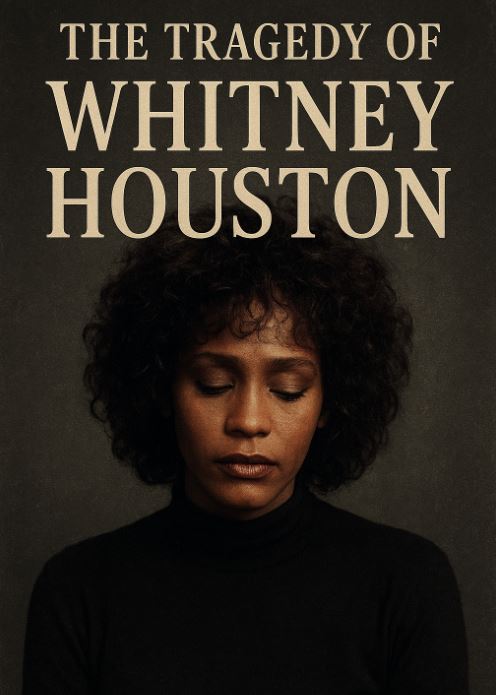
The Tragedy of Whitney Houston
A story told from the shadows
The first encounter with a goddess
I still remember the first time I heard her voice. It happened in an old record store on a rainy afternoon in the eighties, when a song played that froze my blood. It wasn’t just a melody; it was a presence — something too perfect, too pure. I looked around, but no one else seemed to notice that something supernatural had just happened.
“That’s Whitney Houston,” the clerk said with a smile. “The girl with the golden voice.”
But I didn’t hear gold. I heard fire. Something burning behind those crystalline notes, as if a part of her was consumed every time she drew breath to sing.
From that moment, I was spellbound. I began to follow her—not as a fan, but as someone afraid of what they admired. There was something about her that transcended the human.
The birth of an angel
Whitney Elizabeth Houston was born in Newark, New Jersey, in 1963. She was the daughter of Cissy Houston, a gospel singer who had performed with Aretha Franklin. From childhood, she grew up among pulpits and microphones, hearing voices that praised the glory of God — voices that awakened in her something darker: a need for perfection that could never be satisfied.
They say that children of music are marked from birth, and Whitney was no exception.
As a teenager, everyone saw her light, but I saw the pressure that light created. With every round of applause, a piece of her innocence vanished. It was as if the world was molding her with the hands of a cruel sculptor.
At nineteen, she had already worked as a model and background singer, but soon destiny opened both the gates of heaven and hell for her. Her voice captivated Clive Davis, the legendary producer at Arista Records, and in 1985 she released her debut album. From that point on, the myth began to form — but at a silent cost.
The gift and the curse
Success came instantly. The charts bowed before her, radio adored her, and the crowds didn’t know whether they were witnessing a woman or a divine force.
I saw her once, at a concert in Los Angeles. When she stepped onto the stage, the air changed.
The crowd screamed, but I felt something else: the sound of sacrifice. Every time Whitney opened her mouth, she gave away a part of her soul. She was like a high priestess in a trance, offering her light to a crowd that demanded more and more.
The audience didn’t know, but each chord was a pact.
Each high note, a tear in her spirit.
And so, while the world worshipped her, the emptiness within her grew.
Fame, the invisible monster
The tours, the awards, the cameras—it all looked like a dream, until it stopped being one.
Fame might look like paradise from the outside, but once you’re inside, it becomes a labyrinth with no way out.
By the mid‑1990s, Whitney began showing cracks. Her relationship with Bobby Brown, the wild star of R&B, was the first sign of her fall. She loved him with a devastating intensity, but together they created a storm. What began as passion turned into addiction, jealousy, and isolation.
I saw interviews where her smile looked like a mask. Behind those eyes, something was broken.
The monster of fame no longer adored her—it was consuming her.
The shadows of love
Whitney and Bobby’s love was a ritual of fire.
They told each other they were saving each other, but in truth, they were dragging one another down. Through the 1990s and 2000s, her life became a battlefield. Drugs, tabloids, and her own fears imprisoned her inside the image that the world demanded.
In every interview, her voice changed. It no longer sounded like the angel who once mesmerized the world, but like a weary spirit. She tried to keep her faith, but the darkness had stronger claws.
Some said she locked herself in at night to sing alone before the mirror. Sometimes she cried. Other times she laughed for no reason. People who saw her claimed she was talking to someone who wasn’t there — maybe the shadow that had followed her since her first record.
The fall of an idol
The new century arrived, and with it, her decline.
That once divine weapon—her voice—began to crack. Some called it natural aging, but I don’t believe that. It was the curse taking hold.
You could see everything in her gaze: the pressure, the regret, the ghosts of impossible perfection.
Whitney kept trying to come back, but the world no longer listened the same way.
Admiration had turned to judgment.
Her old fans whispered, the media feasted, and she desperately tried to rescue the Whitney she used to be.
But innocence never returns. Once a soul fractures, it doesn’t mend—it turns to dust.
The hotel and the silence
(February 11, 2012)
That night, I couldn’t sleep. There was something in the air—an omen hanging over everything.
At dawn, I turned on the TV, and the words cut through me like frozen glass:
Whitney Houston has died.
They said she was found lifeless in the bathtub of her suite at the Beverly Hilton Hotel.
The official cause: accidental drowning combined with drug use. But I didn’t believe it.
Not entirely.
I imagined the scene: the warm water, steam erasing her reflection from the mirror, and her, alone, listening to the echo of her own breathing. Maybe she sang one last time — a note that only the dead could hear.
Her daughter, Bobbi Kristina, would later meet a similar fate, as if the curse had carried on, as if her mother’s blood held the echo of that tragedy.
The voice that never dies
Years have passed, yet sometimes, when I hear her songs, I feel she never left.
Her voice still floats somewhere between reality and memory.
Some say voices never die — but Whitney’s doesn’t just live… it endures as a warning.
Every verse she sang carries a trace of sorrow, a prayer disguised as a hymn.
When she sang “I Will Always Love You,” people thought of eternal love.
I think of farewell.
Of someone who knew her time was running out — whose brilliance was now a fire feeding on itself.
Sometimes I believe that true artists are ghosts while they’re still alive: beings trapped between this world and another, sustained by their own gifts.
Whitney was the finest example.
Her talent made her immortal—and immortality always comes with a price.
Epilogue: the voice from the darkness
I have never heard anyone sing like that again. No other voice has had that purity, that emotional force that makes you hear yourself through someone else.
But I’ve never felt so frightened listening to music either.
Whitney Houston was more than a singer — she was a living warning of what happens when the world demands perfection from a soul that only wants to be loved.
Her story isn’t just a modern tragedy; it’s a horror story disguised as a biography.
A reminder that even angels can fall, and that fame, when left unchecked, feeds on the brightest souls.
And though she no longer walks among us, her voice remains — drifting, haunting, searching for peace within the echo of every song.
Sometimes, late at night, when everything is silent and I put one of her records on, I can almost hear her whisper:
“I never wanted to be eternal. I just wanted to sing.”