Celebrity news
Robin Williams: The Hidden Disease Behind His Final Years
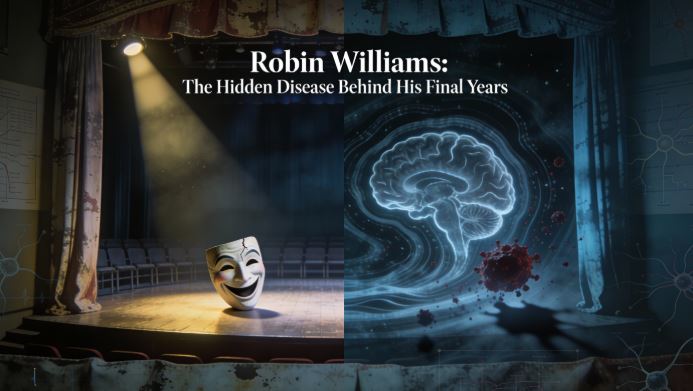
The house on the hill had once been a place of laughter.
Posters from old movies curled slightly at the corners, their colors faded by years of sunlight and the ghost of cigarette smoke. A framed photograph—three comedians mid‑improvised bit, mouths open in wild laughter—hung slightly crooked above the mantel, as if no one had ever had the heart to straighten it. The neighbors still pointed to that house when giving directions.
“You know, the one where the funny man used to live.”
They never said his name aloud, as if it might summon something they weren’t prepared to face.
Inside, the living room clock ticked with a patience that was almost cruel. On the coffee table lay a scattered pile of scripts, half‑finished notes in the margins: little arrows, underlined jokes, question marks next to scenes that needed punching up. In the margins, between crossed‑out lines and rewritten punchlines, were strange fragments—questions that weren’t about the scene at all.
What if the audience laughs but I don’t feel it anymore?
Why does the world look slightly dimmer this year?
Is it possible to be surrounded by people and feel like I’m in an empty room?
To anyone else, they might have looked like odd scraps of brainstorming. To him, they were something else entirely.
For decades, his life had been measured in applause. The louder the room, the safer he felt. Laughter was armor; the spotlight, a kind of anesthetic. When strangers recognized him on the street, their faces lit up before they even spoke.
“You helped me through my divorce.”
“You got me through chemo.”
“You saved me in high school.”
He collected those confessions like medals. Each one proved that his darkness produced someone else’s light. And if he could keep doing that—if he could keep turning his inner storms into jokes—maybe, just maybe, the storms would never fully break.
But storms do not negotiate.
At first, it was subtle. He began to misplace words, tiny slips in the middle of stories he had told a thousand times before. A name lost here, a punchline delivered slightly out of order there. He laughed it off on stage, blamed it on age, on jet lag, on the chaos of traveling so much.
Offstage, alone in his dressing room, the mirror did not laugh with him.
One night, after a show that went well by every measure—standing ovation, selfies in the lobby, the usual chorus of thanks—he sat in front of that mirror longer than usual. The makeup light buzzed overhead; the air smelled faintly of sweat and cologne and old theaters.
“You killed,” his manager had said. “They adore you. Same as always.”
Same as always.
He stared at his reflection, at a face the world associated with joy. He saw lines that hadn’t been there before, but that wasn’t what bothered him. It was the eyes. They looked like someone had dimmed a switch inside his skull.
He raised his hands, made a face, tried out a bit he had used in countless interviews—a silly impression, a burst of comedic nonsense. It still worked. The timing was still there. The character still arrived on cue like muscle memory.
But when he stopped, the silence in the room felt heavier than it used to. It pressed on his chest with invisible hands.
Later that night, lying awake in a hotel room with the curtains half open, watching the city lights blink like distant satellites, he tried to name the thing he felt.
Not sadness. That implied a reason. This was more like being underwater in a pool you could see out of but couldn’t swim up from. The surface was right there, a shimmer of normal life just above his fingertips, and yet every movement felt weighted.
Depression had always been an unwelcome extra in his life—a figure lingering at the edge of the set, waiting for its cue. He had known it for years, sometimes as a quiet shadow in the corner, sometimes as a full‑blown intruder that kicked down the door. He had tried medication, therapy, meditation, exercise. He had sobered up, straightened out, rebuilt parts of his life he thought were permanently broken.
But this felt…different.
It was not just emotional. It was physical in a way that unsettled him. His hands shook slightly when he reached for his coffee in the morning. His movements felt a half‑beat slower, as if someone had inserted a frame of film between every gesture. Jokes took just a fraction of a second longer to form in his mind. On stage, where everything depended on instinct, on speed, on the rapid firing of thoughts like fireworks, that half‑second felt like a chasm.
He told himself it was stress. Work. Age. The accumulation of decades.
Until the day even his wife noticed.
“You’re moving differently,” she said gently, one morning when the light slid across the kitchen tiles and outlined his silhouette as he shuffled toward the coffee machine. “Not worse,” she added quickly, as if afraid to wound him. “Just…differently. Have you felt it?”
He shrugged it off at first, joked about needing WD-40 for his joints. She smiled, but the crease between her brows did not disappear. Later, when she thought he wasn’t looking, he saw her watching him as he reached for a mug, as he turned, as he walked out of the room.
The smallest movements had become evidence.
When he finally agreed to see a doctor, he treated the appointment like a bit. On the drive over, he practiced jokes about getting old, about the indignity of medical gowns, about the universal fear of bad news. The jokes calmed him. They gave him something to do with his hands.
The doctor’s office was all neutral colors and framed degrees. There were questionnaires about mood and sleep, about appetite and feelings of hopelessness. Those, he knew how to answer. He had lived alongside depression long enough to recognize its patterns. He could describe the weight in his chest, the mornings that felt like climbing out of glue, the nights when his mind replayed every mistake he had ever made like a highlight reel from hell.
But when the conversation shifted to movement—how long had he felt slower, had he noticed changes in handwriting, in speech, in coordination—the air in the room grew thick.
“Sometimes,” he admitted. “I forget words. Not complicated ones. Just…words. They’re there, I can feel them right behind a door in my mind, but the door sticks.”
The doctor watched him carefully, eyes soft but assessing.
“And how do you feel about that?”
He wanted to say: Terrified. He wanted to say: Comedy is a dance with language, and if I lose my words, who am I? He wanted to say: The world knows me as quick, as sharp, as electric—what happens if the current falters?
Instead, he smiled a practiced smile and said, “It’s a little annoying on stage.”
The doctor ordered tests. Bloodwork. Scans. Referrals to specialists with longer titles and narrower focus. Each appointment added a new folder to the growing stack on his kitchen counter, paper evidence that something was happening inside him that could not be fixed with willpower or punchlines.
He kept working. Of course he did. Work was a life raft.
On set, between takes, he still made the crew laugh. In interviews, the host’s questions bounced off him like tennis balls, his replies fast and inventive, the old magic still there. The world outside the set remained blissfully unaware of the tremors under the surface.
But his inner world was shifting.
At night, the depression returned with more insistence, no longer content to lurk. It brought with it a chorus of doubts.
What if you’re becoming a different person?
What if the audience can see it?
What if this is the beginning of the end of the you they love?
He had fought depression for years. It was an enemy he knew, a landscape he recognized even when blinded. But this new element—the strange misfires in his brain, the slowness, the occasional flicker of confusion—felt like something else.
He began researching in secret. Late nights on the couch, the glow of a tablet illuminating his face as he scrolled through articles about neurodegenerative diseases. He saw words like Parkinson’s, dementia, cognitive decline, Lewy bodies, misfolded proteins.
The language was clinical, precise. It did not care about careers or legacies or the human beings trapped inside those definitions.
He read sentences that started with “In later stages, patients may experience…” and had to close the browser, because imagining himself in those later stages felt like staring into a future he was not built to inhabit.
Turning his pain into art—that he knew how to do. Turning his decline into something the public could witness? That felt like a cruelty he could not impose on himself or those who loved him.
His wife noticed the way his humor changed.
There were still jokes, but sometimes they landed a little harder, as if his desperation to keep the mood up gave them a sharper edge. In the quiet moments, when there were no cameras, no microphones, no audience, he seemed smaller, as if someone had reached inside and turned down the volume on his soul.
One evening, as they sat on the couch watching a movie he had starred in years before, she glanced at him and realized he was not watching the screen at all. His eyes were fixed on his younger self—on the fluidity, the ease, the boundless energy—and there was something like grief in his gaze.
“You were brilliant,” she said softly, trying to pull him back to the present, to reassure him that brilliance did not have an expiration date.
He smiled, but his voice was quiet when he replied. “He had more time.”
The official diagnosis came late. Later than anyone would have wanted. Before the final label, there were guesses. Some doctors leaned toward one disorder, some toward another. Sometimes they were wrong. It is the nature of these diseases to wear masks.
What he understood, more than the terminology, was the trajectory. He was facing something that would steadily, mercilessly alter the essence of who he was—the timing, the wit, the impressions, the ability to walk into a room and make it lighter by sheer force of personality.
Depression, which had long whispered that he was not enough, now had new ammunition: You are disappearing.
The people closest to him tried to anchor him. Friends who had known him since his earliest days reminded him that he was more than his work, more than his speed, more than his jokes. That love did not require performance. That the man who sat with them quietly on the porch, watching the sun drift down behind the trees, was the same man they had adored on stage.
Rationally, he believed them. Emotionally, the disease distorted their words. Neurodegenerative illness is not content to erode neurons; it warps the way suffering is perceived, bending thoughts into unnatural shapes. Depression, already a master of illusion, linked arms with this new intruder and whispered that his loved ones would be better off remembering him as he had been, not watching him fade.
There were good days.
Days when he woke with enough clarity and energy to feel like himself again, when the fog lifted and the world sharpened into focus. On those days he made everyone laugh at breakfast, told stories that had his friends doubled over, improvised with the old instinctive rhythm. Those days felt like reprieves, like unexpected extra chapters in a book that had been nearing its end.
But the good days made the bad ones hurt more.
On the bad days, he struggled to get out of bed. The weight on his chest felt like a physical object, an invisible boulder pinning him to the mattress. His thoughts moved slowly, like they were pushing through sand. The house seemed too quiet, every tick of the clock stretching the day into uncomfortable shapes.
He had lived on this knife‑edge before: cycling between bright periods and dark ones. But now the dark carried a specific, chilling question:
If this is the beginning, what does the middle look like? What does the end look like?
His wife sat with him through those days, sometimes talking, sometimes not, knowing that words could only reach so far into the labyrinth his mind had become. She reminded him of the lives he had touched, the people who credited him with their survival. She reminded him that he had fought before and come back.
But this fight was different. A mental illness he had battled for years had been joined by an invisible, progressive disease quietly rewiring his brain. It was not a fair fight, and somewhere deep down, he knew it.
To the public, he remained the man who made everything lighter.
News articles still called him “beloved,” “legendary,” “iconic.” Social media still circulated clips of his interviews, his stand‑up sets, his movie scenes. People shared his jokes when they were sad, as if carrying a little vial of his laughter in their pockets.
No one realized that, behind closed doors, he was facing a battle that no punchline could defuse.
The day everything came to a catastrophic halt, the world responded with shock. The news spread in push notifications and breaking alerts, as if the idea of someone so associated with joy dying in such a way was not just tragic, but impossible. Headlines paired his familiar smiling face with words that felt violently out of place.
People asked: How could this happen to someone like him?
Why didn’t he reach out?
Didn’t he know how loved he was?
Those questions, while human, missed the cruel reality of the illnesses he had been fighting. Depression does not measure love accurately. It distorts it. Neurodegenerative disease does not respect achievements; it eats away at the foundations of self until even the brightest lives feel unstable.
Weeks later, as his family moved through their grief, new information emerged from the silent corridors of pathology labs. Microscopic examinations revealed the truth that had been hiding in the folds of his brain: abnormal protein deposits scattered through regions responsible for movement, mood, sleep, and cognition—distinctive markers of a vicious condition that had gone unnamed during his life.
Lewy body disease.
A neurodegenerative disorder that is often misdiagnosed, that masquerades as other illnesses, that weaves together depression, anxiety, cognitive changes, hallucinations, and motor symptoms in ways that confuse even experienced clinicians. A condition that can make reality itself unreliable, that fractures perception, that amplifies despair by altering the very organ that processes it.
Suddenly, pieces of his final years snapped into place.
The subtle memory lapses.
The slowed movements and tremors.
The fluctuations in alertness.
The intensifying depression that did not respond to familiar treatments.
The sense of being trapped inside a mind he could no longer fully trust.
The story that had, on the surface, looked like a man “losing a battle with depression” was, in truth, far more complex and cruel. He had been fighting on two fronts: against a mood disorder he had known for years and against an aggressive, overlooked disease quietly dismantling his neural networks.
The real mystery had not been why he suffered. It had been how he managed, for so long, to keep making the world laugh while such a storm raged inside him.
In the end, the most haunting part of his story is not how it finished, but how it reframes everything that came before. Those late‑career performances, the interviews where his eyes seemed a fraction more tired, the moments when his timing slipped by a millisecond—these were not signs of a fading star, of a man past his prime.
They were the visible edges of an invisible war.
And the man at the center of it had done what he had always done: taken his pain, disguised it behind characters and voices and improvised brilliance, and offered the world the only thing he felt truly qualified to give—laughter.
What the world did not see, until after he was gone, was how much that gift had cost him in the end.
Robin Williams did not just “struggle” with sadness; he fought for years against major depression while an undiagnosed, rapidly advancing neurodegenerative illness—Lewy body disease—was attacking his brain, altering his perception, cognition, movement, and mood in ways that made his final battle unimaginably hard.